

Oklahoma Money Matters (OKMM) is the personal finance education program of the Oklahoma College Assistance Program (OCAP), a division of the Oklahoma State Regents for Higher Education (OSRHE). OKMM gives K-12 schools, higher education campuses, businesses, and community partners the resources they need to help Oklahomans make confident money decisions, from budgeting and credit to saving, financial aid, and student loan management.
OKMM was one of three OSRHE program sites we redesigned this cycle. It joined OCAP, its parent division, and OKPromise, the state’s flagship scholarship program, in a coordinated effort to align all three with WCAG 2.1 AA standards. What began as an accessibility compliance requirement turned into an opportunity to modernize properly, and OSRHE and PixelMongers used it to rebuild each site on a foundation that would hold up over time instead of patching aging templates. This case study looks at OKMM, where that work went furthest and included two custom WordPress plugins.
The Challenge
OKMM’s content was still current and useful. The site around it had simply aged. Built about 15 years ago in Adobe Dreamweaver with static HTML, CSS, and Server Side Includes, it came from a time before smartphones drove most web traffic, and it couldn’t flex to the screen sizes people use today. Dreamweaver itself has sat in maintenance mode for years now, with no new feature development from Adobe and no committed long-term roadmap, so the tooling behind the site was heading toward a dead end even while the content held up. On top of that, the site fell short of the accessibility standards OSRHE was raising across all of its web properties.
In our kickoff sessions with the OKMM team and OSRHE’s Communications staff, we mapped out what the rebuild needed to accomplish:
- Align a dated, non-responsive site with WCAG 2.1 AA, Section 508, and Oklahoma EITA standards
- Migrate roughly 65 pages of content, PDFs, and linked resources into WordPress
- Replace the SurveyMonkey forms and quizzes with accessible, self-hosted versions
- Rebuild a legacy ASP.NET budget calculator that wasn’t mobile-friendly or accessible
- Rethink how the 14 personal financial literacy standards were delivered and reported to teachers
- Deliver a formal VPAT documenting how the site measures against WCAG 2.1 AA
The calculator and the quizzes were the hard part. Neither had an off-the-shelf answer that cleared the accessibility bar, so we built both as custom plugins.
Our Approach
A Modern, Accessible WordPress Rebuild
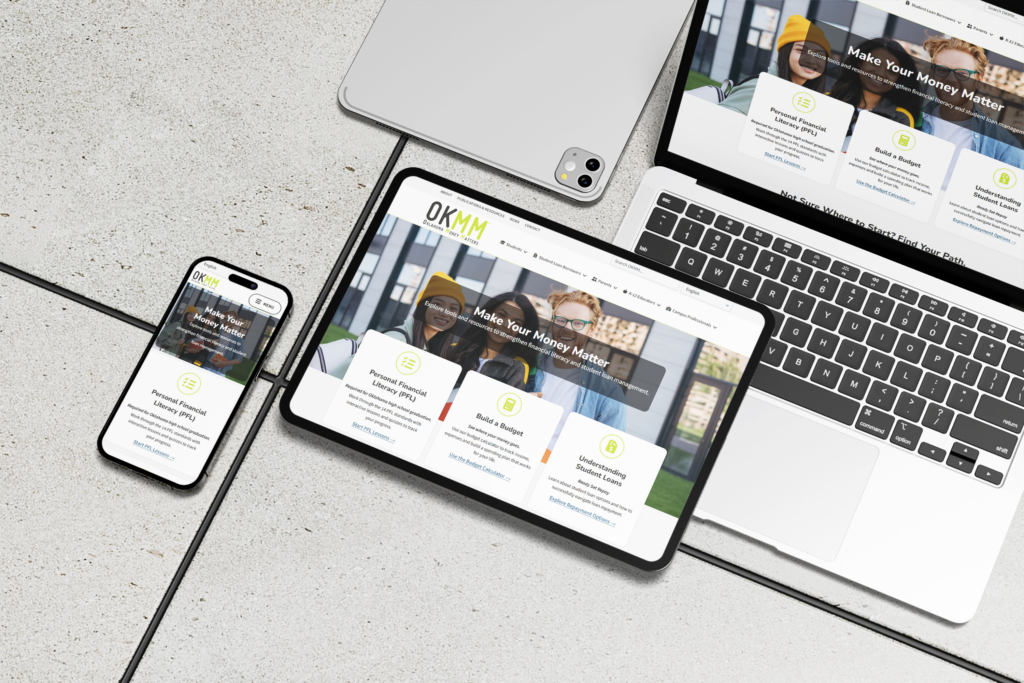
We migrated OKMM off its static Dreamweaver structure and onto WordPress, using the Beaver Builder framework already standardized across OSRHE sites. That standardization worked in the project’s favor. In our accessibility work, Beaver Builder has consistently produced some of the cleanest, lightest markup of the page builders we use, which gives the accessibility work a real head start before any hand-tuning begins. During discovery we presented two design directions and worked through them with the OKMM team before settling on the final look. The result is a responsive site with role-based navigation, so students, parents, borrowers, K-12 educators, and campus professionals each have a clear path to what they need.
Custom Budget Calculator Plugin
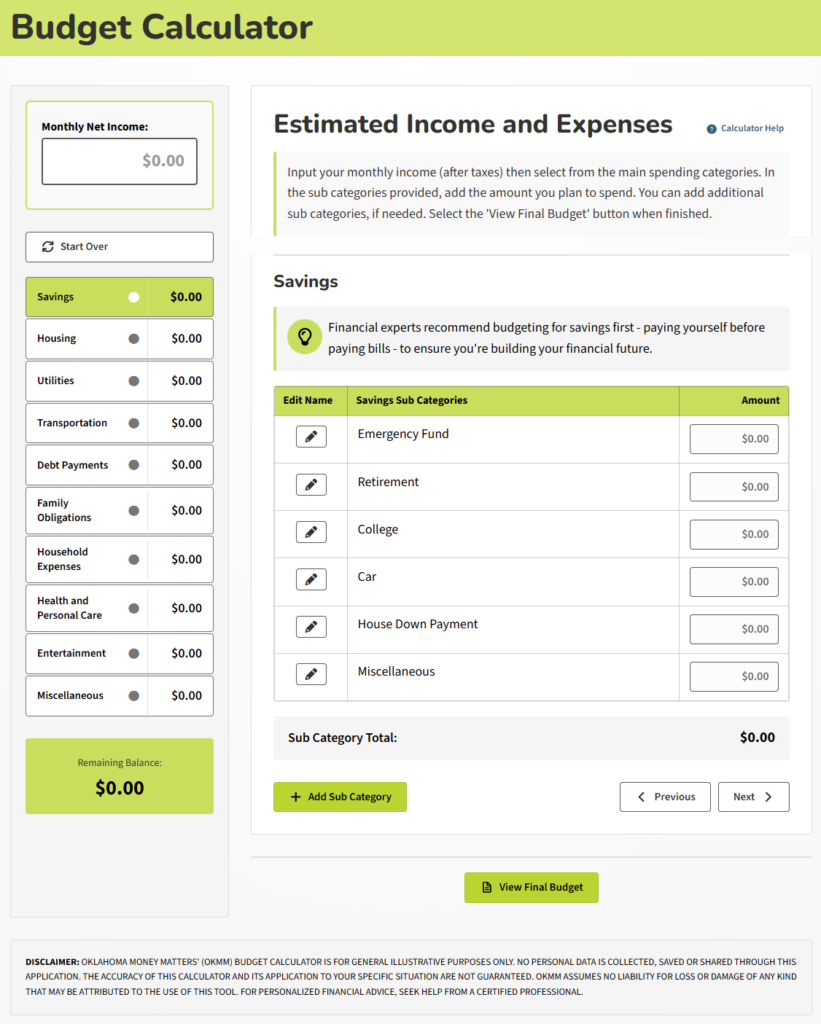
OKMM’s original budget calculator ran on outside ASP.NET hosting, didn’t work well on phones, and failed WCAG 2.1 AA reflow requirements. The underlying math, though, was solid and proven over years of use. So instead of starting over, we carried that existing calculation logic forward and modernized it into a native WordPress plugin, wrapping it in an accessible tabbed interface with proper ARIA support, real-time calculations in the browser, full mobile responsiveness, and print and export options. Nothing users enter is stored anywhere; the math happens client-side. And because the tool now lives inside WordPress, OCAP owns and maintains a resource that sits at the center of the program.
Custom PFL Quiz Hub Plugin
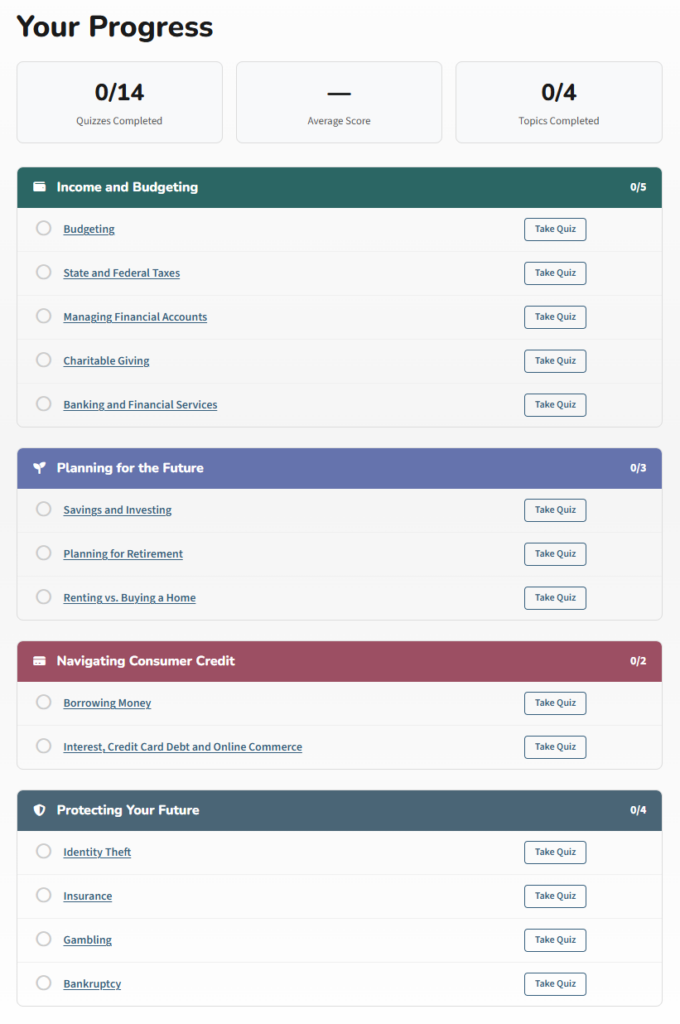
OKMM’s quizzes line up with the Oklahoma Academic Standards for Personal Financial Literacy, the 14 areas of instruction set by the Passport to Financial Literacy Act. Starting with the 2025-2026 school year, Oklahoma students have to complete personal financial literacy coursework tied to these standards in order to graduate, which makes accessible, standards-aligned assessments useful to teachers right now. Working together in our kickoff meeting, the OKMM team and PixelMongers grouped the 14 standards into four categories that reflect how the material is actually taught: Income and Budgeting, Planning for the Future, Navigating Consumer Credit, and Protecting Your Future. From there we built a custom Quiz Hub on Gravity Forms. Each quiz runs one question at a time with immediate right-or-wrong feedback and a short explanation before moving on, which keeps it quick and workable for screen reader and keyboard users. Reporting is organized by module completion rather than isolated quiz activity, so teachers can see standards-level outcomes as classroom use grows.
Accessible Forms, Search, and Media
The general forms were rebuilt in Gravity Forms with an accessible CAPTCHA, full validation and error handling, email confirmations for both the submitter and staff, and CSV, Excel, or PDF export. We added an accessible sitewide search, brought in the translation switcher OSRHE uses on its other sites, embedded the program’s YouTube videos with proper titling, and set up SEO and analytics through Yoast and Google Tag Manager.
Quality Assurance and the Accessibility Conformance Report
Everything interactive went through both automated and manual testing: Microsoft Accessibility Insights, Lighthouse, and hands-on NVDA screen reader and keyboard checks. That testing fed directly into a completed VPAT, delivered to OCAP as an Accessibility Conformance Report (ACR). The report documents, criterion by criterion, how the site measures against WCAG 2.1 Levels A and AA and the Revised Section 508 standards, so OCAP can hand it straight to reviewers and procurement staff. Where a handful of criteria only partially conform, nearly all trace to third-party components like the translation widget and a forms plugin, and each is logged with its current status and a remediation path rather than left unstated.
Outcomes
The rebuilt OklahomaMoneyMatters.org gives OCAP a site that’s easier to use and easier to maintain:
- Designed and tested to WCAG 2.1 AA standards, with mobile responsiveness across the site
- Two custom plugins, the Budget Calculator and PFL Quiz Hub, replacing fragile outside dependencies with tools OCAP owns
- Full plugin source and maintenance documentation delivered to OCAP, with commented code, so the tools can be maintained by any developer with no vendor lock-in
- Quiz reporting organized around the standards teachers actually teach to
- Navigation built around the site’s real audiences
- A completed Accessibility Conformance Report (ACR) documenting the site against WCAG 2.1 A/AA and Section 508, ready for procurement review
- OCAP staff able to manage content, forms, and the homepage feature area themselves
This was one of three connected rebuilds. OCAP and OKMM each shipped with a completed ACR, and OKPromise follows at its launch, giving OSRHE consistent, accessible footing and matching documentation across all three programs.
Frequently Asked Questions
Yes. Beginning with students who entered ninth grade in the 2025-2026 school year, Oklahoma requires completion of personal financial literacy coursework covering the state’s 14 areas of instruction, satisfied during grades 10 through 12, to graduate with a standard diploma. The requirement traces to the Passport to Financial Literacy Act. OKMM’s quizzes are aligned to those same standards.
They are 14 areas of instruction, covering topics such as earning an income, taxes, banking, saving and investing, borrowing and credit, insurance, and identity theft, that Oklahoma students in grades 7 through 12 are expected to learn. OKMM organizes its quizzes into four modules mapped to these standards so educators can track outcomes at the standard level rather than quiz by quiz.
A VPAT (Voluntary Product Accessibility Template) is the blank template; an ACR (Accessibility Conformance Report) is the completed report produced from it. When a procurement team asks for “a VPAT,” they usually mean the finished ACR. OKMM’s accessibility is documented in a completed ACR covering WCAG 2.1 Levels A and AA and Revised Section 508, ready for procurement review.
In our experience building WCAG-focused sites, Beaver Builder produces cleaner, lighter markup than most page builders, which reduces the amount of remediation needed. It is a strong starting point, though no page builder is fully conformant out of the box. Meeting WCAG 2.1 AA still requires manual testing and hand-tuning.
Yes. OKMM’s calculator was rebuilt as a native WordPress plugin with an accessible tabbed interface, proper ARIA support, real-time in-browser calculations, and a responsive layout that satisfies the 1.4.10 Reflow criterion. Because it stores no user data, calculations stay entirely on the user’s device.
Under the U.S. Department of Justice’s ADA Title II rule, state and local government entities, including public universities and their programs, must make web content conform to WCAG 2.1 AA. In 2026 the compliance dates were extended to April 2027 for larger entities and April 2028 for smaller ones. Oklahoma’s own IT Accessibility Standard and Section 508 apply alongside the federal rule.